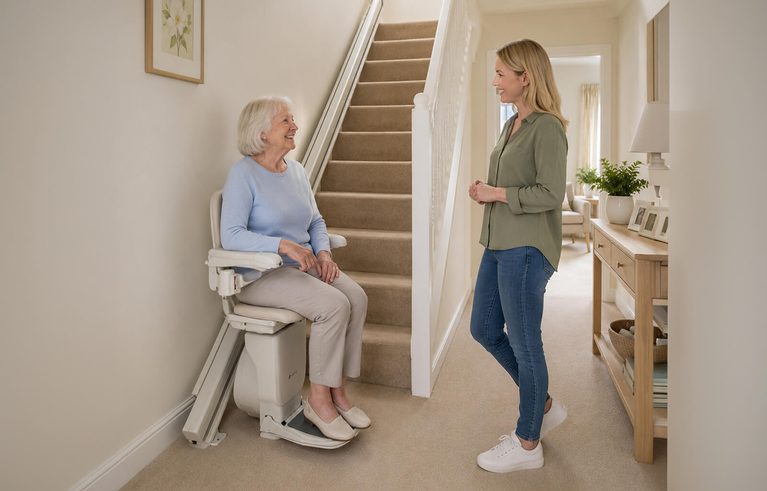
If you’ve started asking this question, there’s usually a reason.
Sometimes there’s been a fall, sometimes it’s just a near miss, or perhaps it’s the growing awareness that the stairs feel less predictable than they once did.
Yet if you’re considering a stairlift, safety is probably your biggest concern. It’s a sensible question. You’re replacing the risk of climbing the stairs with a piece of equipment. You want to know that you’re not swapping one worry for another.
The short answer is yes, stairlifts are safe. Modern stairlifts are designed with multiple built-in safety systems and must meet strict UK safety standards. But safety isn’t just about what’s built into the chair. It’s also about how it’s fitted, how it’s used, and whether it’s right for the person using it.
In this guide, we’ll explain exactly how safe a stairlift is and what you should know before making a decision.
Are stairlifts safe?
For most people who are beginning to struggle on the stairs, a stairlift is significantly safer than continuing to climb them unaided.
Stairs require a level of balance, strength, coordination and concentration. As we get older, or if we’re recovering from illness or surgery, those things can change.
A stairlift removes the need for the physical act of climbing and descending. Instead of stepping up and down, you sit securely and travel at a steady, controlled speed.
Importantly, stairlifts installed in the UK are designed to meet BS EN 81-40, the recognised safety standard for stairlifts and inclined lifting platforms. That standard sets out detailed requirements covering:
- Construction and mechanical design
- Braking and overspeed protection
- Safety devices and stop systems
- Installation requirements
- Testing before first use
Under these regulations, stairlifts are built with the expectation that things can go wrong and designed to prevent that from becoming dangerous.
That doesn’t mean nothing ever happens, but serious mechanical failures in modern stairlifts are rare. In our experience, most issues relate to how the lift is used, not how it’s built.
How do stairlifts work?
In order to understand the safety of a stairlift, it helps to know what you’re actually sitting on.
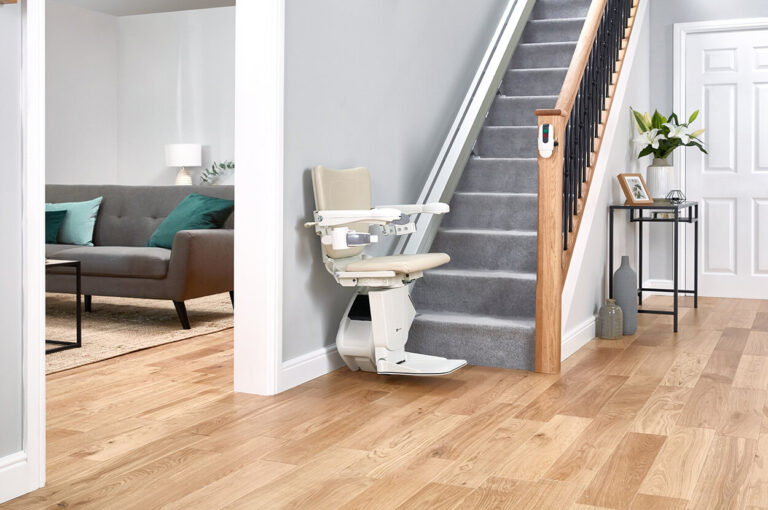
A stairlift isn’t suspended in mid-air or hanging from the wall. The rail is fixed securely to the stair treads themselves, so your staircase carries the weight.
Inside that rail is a geared drive system, most commonly known as a rack-and-pinion mechanism. A small motor turns a gear, which moves steadily along a toothed strip inside the rail.
This design prevents slipping or free movement. If the motor stops, the lift stops.
Most stairlifts use what’s called “hold-to-run” controls. That means the chair only moves while you keep gentle pressure on the switch. If you let go, the stairlift stops immediately.
Stairlifts travel at around a slow walking pace, and there are no sudden accelerations. Modern models are designed to start and stop gently, so you don’t feel jolted and become unsteady.
Additionally, another point many people don’t realise is that stairlifts run on rechargeable batteries. Even though they’re connected to the mains for charging, they operate on battery power.
This means that if there’s a power cut, the lift continues to work, so you won’t be stranded halfway up the stairs because of a brief outage.
All of these features are intentional. The engineering is designed around control and predictability, which in turn supports your balance and coordination.

What are the stairlift safety features?
When people ask about safety, they often want to know what happens if something goes wrong. The answer to that question lies in the layers of protection built into the lift.
The seatbelt
The most visible and recognisable safety feature is the seatbelt, which keeps you securely positioned during travel. Particularly for anyone with reduced balance or core strength, it prevents sliding forward or sideways.
Remember: the seatbelt should be worn every time. Skipping it is one of the few avoidable risks.
The swivel seat
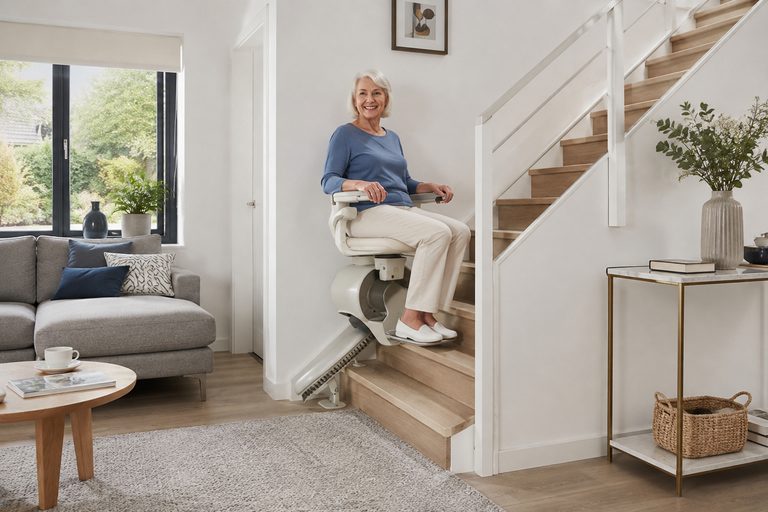
At the top of the stairs, the seat swivels towards the landing, meaning you step off onto a flat surface, not onto the top step. This is one of the most valuable safety features, as it significantly reduces the risk of a fall.
The swivel locks into place, so it cannot turn while the lift is moving. You only rotate when it’s safely parked.
Obstruction sensors
Stairlifts include pressure sensors around the footrest and carriage. If the lift touches something on the stairs, such as a shoe, a walking stick, or even a curious pet, it stops automatically.
It’s not a dramatic stop. It simply pauses movement until the obstruction is removed, removing the possibility of something getting jammed into the mechanism.
Braking and overspeed protection
Under BS EN 81-40, stairlifts must include systems to prevent uncontrolled movement. This means there are braking mechanisms and safety devices designed to engage if the lift were ever to move faster than intended.
The drive system itself is geared in a way that resists free movement. The chair cannot simply “roll” down the rail. Movement only happens when the motor drives it. If power is removed, the lift stops.
In addition to this, stairlifts include braking mechanisms that engage automatically if something isn’t operating as expected. These systems are tested before the lift is put into use.
You won’t see these components working, and that’s the point. They are designed to prevent rare mechanical issues from becoming dangerous situations.
It’s similar to safety features in a car. You don’t notice them during normal use, but they’re there to protect you if something unexpected happens.
Weight limits
Every stairlift has a maximum rated weight, which is based on how the lift has been engineered and tested.
The motor, rail, carriage and braking systems are all designed to operate safely within a specific load range. Staying within that range ensures smooth, controlled movement, reliable braking performance, and long-term mechanical performance.
During a home assessment, the installer will confirm the user’s weight and ensure the model selected is suitable. If needed, heavy-duty models are available that are designed to accommodate higher weight capacities safely.
Exceeding the rated limit can place unnecessary strain on the system. That’s why it’s important to be open during assessment and choose the correct model from the outset.
Key switches and remote controls
Many stairlifts include a key switch. When turned off, the lift cannot be operated. This is particularly useful in homes with visiting grandchildren or where there’s concern about someone playing with the controls, so that the lift is only used intentionally.
Remote controls allow the chair to be called to the top or bottom of the stairs without anyone needing to climb the steps to retrieve it. In households with more than one user, remote controls also prevent unnecessary trips on the stairs, keeping movement controlled and predictable.
Are stairlifts dangerous?
Modern stairlifts are not inherently dangerous, but like any piece of equipment, they must be used properly. When incidents occur, they usually involve one of three situations:
Getting on or off too quickly
The highest-risk moment of using a stairlift is during mounting and dismounting, not in transport.
If someone tries to rise before the seat has fully swivelled towards the landing, they can feel unsteady. If they rush or attempt to step away too quickly, balance can be compromised.
This is why proper installation matters. A good survey ensures there is enough safe, flat space at the top and bottom of the stairs to step off comfortably. During handover, users are shown exactly how to swivel, lock the seat, and stand safely.
Remember: taking a moment, rather than rushing, removes most of this risk.
Not wearing the seatbelt
It’s easy to become complacent, especially if the journey is short. But the seatbelt exists to prevent sliding or leaning forward during movement. For someone with reduced core strength or balance, even a gentle start or stop could feel destabilising without it.
Wearing the belt each time is one of the simplest and most effective safety habits.
Skipping servicing
Stairlifts contain moving parts and rechargeable batteries. Over time, batteries weaken, sensors need checking, and small issues can develop.
Regular servicing ensures everything continues to operate as intended. It’s less about dramatic breakdowns and more about preserving consistent, reliable performance. At Simply Stairlifts, we can provide comprehensive and cost-effective stairlift servicing to ensure your stairlift is working properly.
Are stairlifts a good idea for everyone?
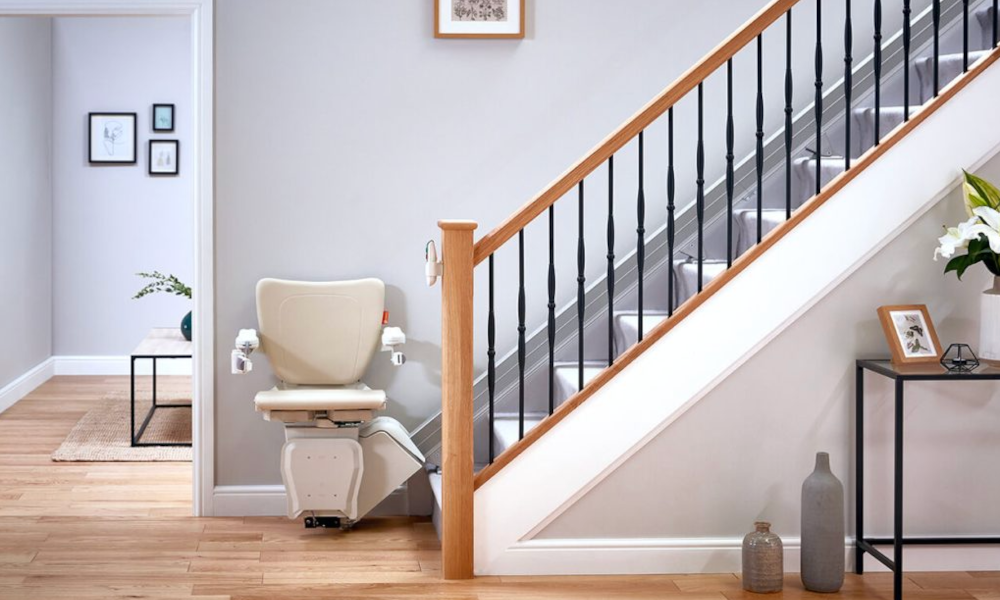
In many cases, a stairlift is an excellent solution. But it isn’t automatically the right answer for every person or every home.
The decision should be based on two things: the individual’s needs and the layout of the property.
When a stairlift is often the right choice
A stairlift tends to make sense when the stairs themselves have become the main obstacle to staying independent.
We often see it become the right step when:
- There have been near-falls or a loss of confidence on the stairs
- Climbing leaves someone breathless or fatigued
- Arthritis, knee pain or hip problems make lifting each leg difficult
- Recovery from surgery or illness has reduced strength
- Someone is avoiding using the upstairs altogether
In these situations, the risk of continuing to use the stairs often outweighs the perceived risk of installing a lift.
When a stairlift needs careful consideration
There are also circumstances where a stairlift may not be the most suitable solution, or where additional assessment is essential. For example:
- If someone has significant cognitive impairment and may struggle to operate the controls safely or remember to use the seatbelt
- If trunk stability is severely reduced, sitting upright safely without additional support might be difficult
- If someone cannot transfer independently from standing to sitting, or vice versa, extra equipment or carer support may be required
None of these automatically rule out a stairlift, but they do highlight why a proper home survey matters.
So how safe is a stairlift?
For someone beginning to struggle with the stairs, a stairlift doesn’t add risk. When professionally installed, properly used, and regularly serviced, they are one of the safest ways to maintain independence in a multi-storey home.
If you’re unsure whether a stairlift is right for your home, the safest next step isn’t to guess. It’s to have a proper assessment, ask your questions, and understand your options clearly. Simply Stairlifts is here to offer reassurance, guidance and professional support whenever you need it.
Our experienced electrical and mechanical engineers are qualified to install, remove, repair and service any stairlift in South West England. If you need to book in a stairlift repair or require a new or reconditioned stairlift, you can contact our team today to see how we can help.
Contact our team now
Find out more helpful information about stairlifts on the Simply Stairlifts advice page…
How much does a stairlift cost? | What to look for in a stairlift supplier? | Funding a Stairlift: Everything You Need to Know About Stairlift Grants