Nobody plans for a stairlift. One day the stairs are fine. Then they’re not, and suddenly you’re googling something you never expected to google, trying to make sense of a product you know almost nothing about at a moment when you probably have bigger things on your mind.
In this article, we’ll look at the different types of stairlifts, how to work out what you need, and cover any questions you may have. Keep reading to learn more…
The main types of stairlift
Stairlifts vary in purpose and design, so finding the right one to suit your needs starts by understanding how each performs:
Straight stairlifts
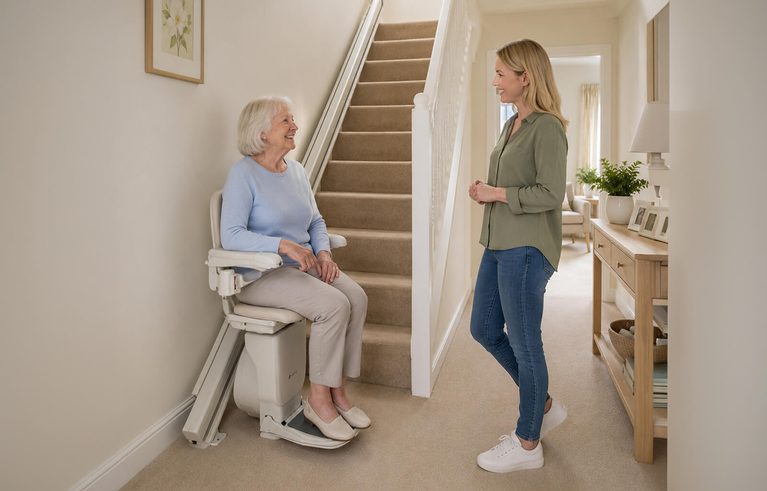
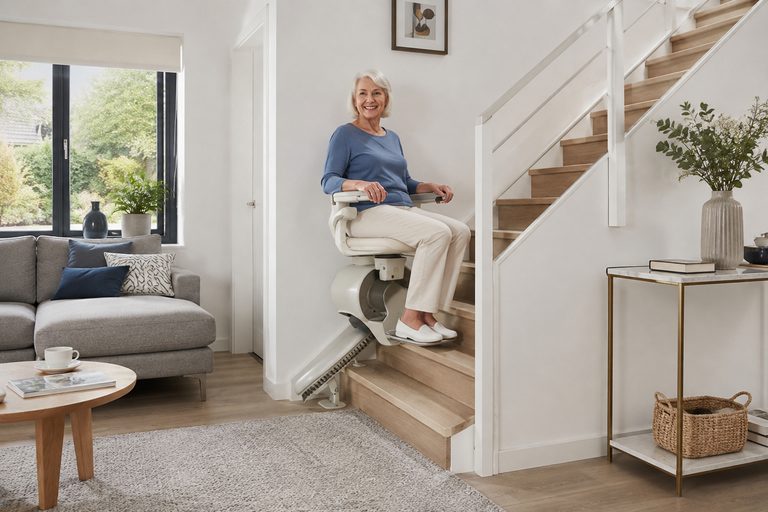
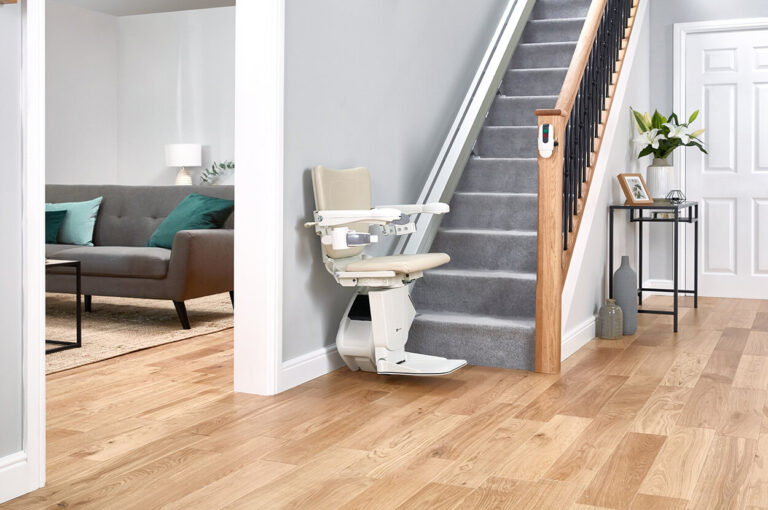
A straight stairlift runs on a single rail fixed to the stair treads. If your staircase goes straight up from bottom to top with no turns, no landings, and no bends, this is the type you need.
It’s also the most common type in UK homes, which makes it the most competitively priced and the quickest to fit. Most straight lifts go in within half a day.
New models from the main manufacturers, such as Acorn, Stannah, Handicare, typically start around £1,500 and go up to about £2,500 depending on rail length and features.
Reconditioned straight stairlifts start from around £1,200. Most standard straight lifts have a weight capacity of 120–130kg, though heavier-duty options exist.
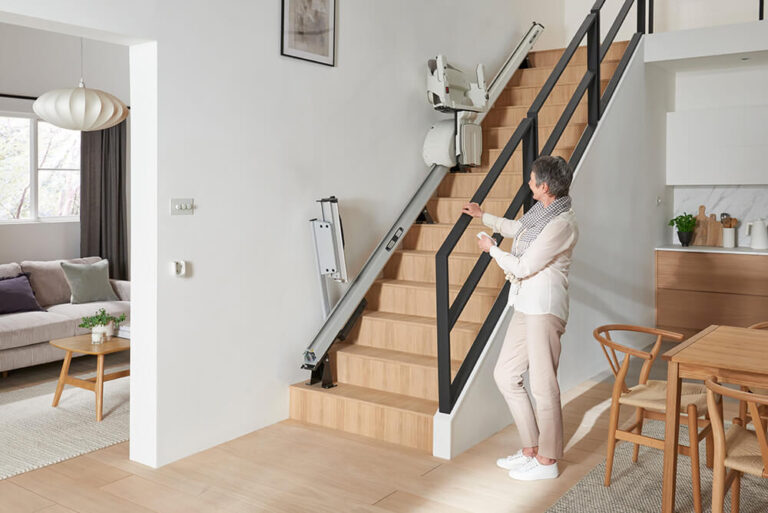
Controls are designed to be simple, with a joystick or rocker switch on the armrest, plus a remote so someone downstairs can call the lift back.
If your stairs are straight, the decision is more or less made for you.
Curved stairlifts
Curved stairlifts cover different stairlift designs, including stairs with a landing halfway up, an L-shape, a U-shape, or even a full spiral. The rail is made to order, custom-bent to match the exact geometry of your staircase. That’s why they cost more and take longer to fit.
A new curved stairlift typically costs between £3,000 and £5,200. The variation comes down to the complexity of the rail. A single 90-degree turn is simpler than a full spiral, and staircase length matters too.
Simply Stairlifts supplies and installs curved models up to around £5,200 for new units, with reconditioned curved options also available, though stock varies.
If you’re not sure whether your staircase counts as curved, a free home survey will settle it. You don’t need to measure anything beforehand.
Other types of stairlift
Straight and curved cover most staircases, but there are a few more specific types that you may require:
Stairlifts for narrow stairs
A lot of Victorian and Edwardian terraces, the kind of houses common in Bath, Bristol, and across Wiltshire, have stairs that feel genuinely tight. The minimum width for most stairlift rails is around 600–620mm, measured at the narrowest point. Below that, you’re into specialist territory.
Slimline models are made specifically for narrower staircases. The sensible thing is not to rule yourself out based on a tape measure and a rough guess. A home assessment will confirm whether a standard model fits or whether a slimline option is needed.
Outdoor stairlifts
Some properties have external steps, such as a front door on a slope, down to a garden, or between levels on a split-level home.
Outdoor stairlifts are built for this. They use weather-resistant materials, a covered rail, and upholstery that can handle rain. They’re not a common purchase, but they solve a problem that an indoor lift can’t.
Perch and standing stairlifts
A perch stairlift has a small angled saddle rather than a conventional seat, so the user rests against it with their knees close to straight throughout the ride. These are for people who genuinely can’t fully bend their knees, such as after knee or hip surgery, or with severe arthritis.
They’re not a simpler or easier version of a standard stairlift. They need decent upper body stability. But for the right person, they’re the only option that works.
Whether someone actually needs a perch seat rather than a standard one is worth discussing properly during a home survey, because it’s not always obvious from the outside.
New vs reconditioned stairlifts
Once you know whether you need a straight or curved lift, the next question is whether to go new or reconditioned.
“Reconditioned” can sound like a polite way of saying “second-hand”. It isn’t, or at least it shouldn’t be.
A properly reconditioned stairlift has been removed from a previous installation, stripped back, inspected, had worn components replaced, and been tested before it goes back out. Seats and upholstery are typically replaced too. It leaves with a warranty.
The main question is whether they’re safe. Thankfully, they are, when the reconditioning has been done properly and the supplier stands behind the work.
What’s worth avoiding is a private sale with no aftercare. A lift bought on Facebook Marketplace with no warranty and no one to call if something goes wrong is a bad investment, regardless of the cost.
A reconditioned stairlift from a reputable local supplier with a service agreement is a different thing entirely.
Reconditioned curved stairlifts are harder to come by. Because every curved rail is custom-made, a reconditioned unit can only be reused if the new staircase dimensions are close enough to match, which doesn’t happen often. It’s not unheard of, but it’s not something to bank on.
So how do you decide which to choose? Well, new makes sense if you want a full manufacturer warranty, specific features or colours, or if you need a curved lift where the dimensions need to be exact. However, reconditioned makes sense if you need a straight lift, want to keep costs down, and are happy with a properly refurbished unit backed by aftercare.
Either way, Simply Stairlifts provides the same installation, servicing, and 24-hour emergency support.

How to choose the right stairlift for your home
There’s no quiz that gives you a clean answer. But there are three things that can help you to narrow it down.
The staircase
Start by understanding your staircase. Is there a landing? A door that opens onto the stairs? A radiator in an awkward spot? These are what a surveyor checks. You don’t need the answers before you call, but having a rough sense of your staircase means the first conversation is more useful.
The user
Think about who is going to use the stairlift. Most standard models handle 120–160kg, with heavy-duty options above that. But the specifics of the user matter just as much. Can they get on and off a conventional seat comfortably? Do they have grip or hand issues that affect which controls work best? Is a simple, straightforward layout important because of memory or cognition?
There’s no formal eligibility for a stairlift. Anyone who needs one can get one. Getting the right one for a particular person just takes a bit more thought than the staircase dimensions alone.
The budget
The cost of a stairlift is an important matter. Here is a quick cost summary:
- Reconditioned straight stairlift: from around £1,200
- New straight stairlift: from around £1,500–£2,500
- New curved stairlift: from around £3,000 up to £5,200
Two things a lot of people don’t realise are that stairlifts are zero-rated for VAT if the buyer has a disability or long-term physical or mental condition, a 20% saving that applies automatically if you qualify.
And the Disabled Facilities Grant, administered through local councils, can put up to £30,000 towards adaptations including stairlifts. It’s means-tested, and processing times vary, but for the right household it’s worth looking into. To learn more about stairlift grants, read our article here.
You don’t need to go to the manufacturer
When people start researching stairlifts, they usually end up on the websites of the big national names, such as Acorn, Stannah, and Handicare. They spend a lot on advertising, so they’re easy to find, and they’ve been around long enough that calling them feels like the obvious move.
However, going with national brands means you miss out on a more personal service. Simply Stairlifts installs, services, and repairs any make or model. Not just the ones they sell themselves.
So if there’s already a Stannah or an Acorn in the house and it needs attention, you don’t have to go back to the manufacturer or explain your situation to someone who has never seen your staircase.
The big manufacturers make perfectly good stairlifts. But once it’s installed, what you want is someone local who knows what they’re doing and answers the phone.
Frequently asked questions
Can stairlifts be fitted to any stairs?
Almost always. Straight, curved, L-shaped, U-shaped, spiral, narrow, outdoor – there’s a type built for each configuration. Genuinely impossible cases are rare. A staircase too narrow for any rail to fit safely, or a structural issue that prevents secure fixing. A free home survey tells you where you stand, costs nothing, and comes with no obligation.
How much does a stairlift cost in the UK?
Reconditioned straight lifts from around £1,200; new straight lifts from £1,500 to £2,500; new curved lifts between £3,000 and £5,200. Prices include installation. VAT is zero-rated for buyers with a qualifying disability or long-term condition; that’s 20% off, automatically.
Are reconditioned stairlifts safe?
Yes, when the reconditioning has been done properly. A reconditioned stairlift from Simply Stairlifts has been stripped, inspected, had worn parts replaced, and tested before it’s installed. It comes with a warranty and full aftercare. Buying privately with no backup is the risk, not the idea of reconditioned stairlifts itself.
How long does a stairlift last?
Typically 10–15 years with regular servicing. An annual service keeps the battery, drive mechanism, and safety sensors in good order and catches small problems early. Simply Stairlifts services any make or model, regardless of who originally fitted it.
Can I get financial help towards a stairlift?
Two routes worth knowing. Stairlifts are zero-rated for VAT for buyers with a qualifying disability or long-term condition, 20% off, and no application is needed; just declare it. The Disabled Facilities Grant, through your local council, can contribute up to £30,000 towards adaptations including stairlifts. It’s means-tested, and timelines vary. If you want to look into either, give Simply Stairlifts a call; it’s usually something we can get you clear on without much back-and-forth.
How long does installation take?
Straight stairlifts are usually in within half a day. Curved stairlifts take longer, the custom rail is manufactured first, adding roughly one to two weeks to the lead time, and the installation itself takes most of a day. If timing is pressing, say so when you get in touch. Reconditioned straight lifts can sometimes be turned around faster.
Will a stairlift damage my stairs?
No. The rail fixes to the stair treads, not the wall, and the fixings leave only small screw holes. When a stairlift comes out, because it’s no longer needed, or the house is changing hands, the stairs go back to normal without any lasting damage. It’s a fully reversible change to the home.
Ready for your free survey?
If you’re ready to take the next step, we’d love to come and see you. Our home surveys are completely free; there’s no pressure, and there’s no obligation. We’ll give you our honest advice, show you what’s possible, and let you decide in your own time.
Contact our team today to arrange a free, no-obligation home survey. We cover Wiltshire, Gloucestershire, Somerset, Oxfordshire, Bristol, Bath, and the surrounding area, so if you’re in the South West, there’s a good chance we’re closer than you think.
Contact Simply Stairlifts today
Find out more helpful information about stairlifts on the Simply Stairlifts advice page…
How much does a stairlift cost? | What to look for in a stairlift supplier? | Funding a Stairlift: Everything You Need to Know About Stairlift Grants