Stairlifts are not a typical everyday consideration. But, if you’re struggling with mobility or are watching someone you love cling to the bannister a little too much, it’s better to think about them sooner rather than later. Especially if you’re not sure about the financial side.
Buying a stairlift can be a big upfront expense that you’re not ready for, which is when knowing about the benefits and grants that are available can make a massive difference to your stress levels.
From benefits to the Disabled Facilities Grant, or even short-term renting, we’ll cover everything you need to know about what you’re entitled to, so you can work out a way to get your stairlift fitted when you need it.
Funding your stairlift: an overview
Here’s the honest answer: neither the Personal Independence Payment (PIP) nor Attendance Allowance will directly buy you a stairlift.
But that’s not the end of the story. Neither of these benefits are irrelevant to supporting you, and they are usually vital for maintaining quality of life. Outside of these payments, there is a funded route you can take via your council called the Disabled Facilities Grant that will help you purchase a stairlift for your home.
PIP and Attendance Allowance
Two of the benefits that may help you with the financial aspect of stairlifts are PIP and Attendance Allowance. If you meet the criteria, these are valuable support payments to have.
Personal Independence Payment (PIP)
The Personal Independence Payment, or PIP, is a benefit designed to help you with “extra living costs if you have both:
- a long-term physical or mental health condition or disability.
- difficulty doing certain everyday tasks or getting around because of your condition.”
PIP is available to people below State Pension age and is designed to help you with mobility support, daily living, and making sure you can meet your needs to help you stay independent. It’s a tax-free, non-means-tested benefit that is paid every four weeks.
Unlike some other benefits, you’re eligible for PIP even if you’re working, have savings, or are getting other benefits.
Learn more on the PIP Government Website.
Attendance Allowance
Attendance Allowance is a benefit intended to support you if you have a “disability or health condition severe enough that you need someone to help look after you”. This is an equivalent to PIP available to those over State Pension age.
Support payments are open to those with a physical disability, mental disability, or health condition, or if you’re State Pension age or older to help with personal support. You don’t need someone caring for you in order to claim either.
Note: this does not cover mobility needs.
Where PIP and Attendance Allowance can help
Both benefits are paid to help cover the general extra costs associated with living with a disability, not to any specific purchase. So, if you’ve been searching for PIP stairlift funding, there’s a reason you may have found dead ends. Instead, since neither PIP nor Attendance Allowance will directly buy a stairlift, they are able to support you in other ways.
For example, this money is not ring-fenced for specific allocation. This means these payments can help to alleviate other living costs, allowing you to save up over several months of payments to help get you to the amount needed for a stairlift. Alternatively, you may also be able to use these funds to help you rent a stairlift for a short term while you wait for a grant application to process.
Another reason they matter is that these benefits are disregarded when the council works out whether you qualify for a Disabled Facilities Grant (more on this below).
The Disabled Facilities Grant
The Disabled Facilities Grant is a legal duty on local councils in England, Wales and Northern Ireland, set out in the Housing Grants, Construction and Regeneration Act 1996.
What this means is that your local council has a legal duty to help you with reasonable adaptations to your home to improve your quality of life. For example, this grant is available for you if you:
- Are physically disabled.
- Have a progressive condition, like motor neurone disease.
- Have a cognitive impairment, like dementia.
- Have age-related needs.
It can cover a wide range of accommodations, from improving access in and out of your home, widening doors, installing grab rails, or indeed, installing a stairlift to help you access the upper parts of your home.
Using DFG for a funded stairlift
The grant covers the full cost of assessed adaptations up to £30,000 in England. If a stairlift quote falls within that limit, the council should meet the cost in full, subject to the means test. Above the cap, you may be expected to cover the difference, though some councils have discretionary top-up funding available.
The process works like this: you apply to your local council, usually through their housing or social care team. An occupational therapist (OT) visits your home to assess your needs and produces a report recommending the adaptations required.
That report supports your grant application. Once approved, you gather quotes from contractors, the work is scheduled, and the stairlift is fitted.
The council has up to six months from your application to approve or refuse. Some areas have waiting lists, so the process is rarely fast. If your situation is urgent, make that clear when you apply.
What “means-tested” actually means
The means test assesses your income and savings to work out whether you should contribute to the cost of works, and if so, how much. If the test finds you can afford to contribute, the grant is reduced accordingly. If it finds you cannot, the full cost is covered.
The first £6,000 of your savings is ignored. Anything above that is converted into what’s called tariff income and added to your weekly income figure. The council then deducts a set of personal allowances based on your circumstances, and what remains determines your contribution.
In practice, many people with modest incomes are assessed as owing nothing and receive the full grant. And, as noted above, receiving PIP or Attendance Allowance does not count against you in this calculation.
Getting a stairlift with help from social services
Social services and the DFG are separate routes, but they work together. When you contact your local council’s adult social care team, they can arrange a needs assessment, usually carried out by an occupational therapist.
The OT visits your home, asks about what you find difficult, and observes how you move around the space. They then produce a report on what adaptations would help most.
Smaller adaptations costing under around £1,000 can often be funded by the council directly, without a full DFG application. Grab rails, step modifications, and similar minor changes tend to fall into this category. A stairlift sits above that threshold, so the OT report becomes the supporting evidence for a DFG application.
You can contact your local council directly and ask for an adult social care assessment. You don’t need a GP referral, though your GP can make one on your behalf. In many areas, you can also request an OT assessment through the NHS independently.
Disclaimer
Most benefit rates change yearly in April, and the Disabled Facilities Grant thresholds are set by law. The figures referenced in this article are correct as of August 2026, but can be subject to change in the future. Always refer to your local council or GOV.UK before making your decision.
Frequently asked questions
Here are the questions we get asked most often when people are working out how to fund a stairlift.
Can I get a free stairlift on PIP?
PIP does not fund stairlifts directly, so a “free stairlift on PIP” isn’t something the benefits system provides. What PIP does is help with the general extra costs of living with a disability. Over several months of payments, it may help you build savings toward a purchase or cover renting one short-term while a grant application is being processed. The Disabled Facilities Grant is the more reliable route to a fully funded stairlift.
Does Attendance Allowance pay for a stairlift?
No. Like PIP, Attendance Allowance supports the general costs of living with a disability rather than specific purchases. The payments are not ring-fenced for any particular adaptation. If you’re over State Pension age and want help funding a stairlift, the Disabled Facilities Grant is the more direct route.
Will claiming PIP or Attendance Allowance affect my Disabled Facilities Grant?
No, it won’t. Both PIP and Attendance Allowance are disregarded in the DFG means test. Claiming either benefit will not reduce the grant you receive.
How do I get an occupational therapist to assess me for a stairlift?
Contact your local council’s adult social care team and ask for a needs assessment. They’ll arrange an OT visit. In most areas, you can do this without a GP referral, though your GP can refer you if you prefer. Many NHS trusts also accept self-referrals directly.
The OT will visit your home, ask about the tasks you find difficult, and watch how you manage around the space. The appointment usually takes at least an hour. The report produced afterwards supports your DFG application.
How much can I get from the Disabled Facilities Grant for a stairlift?
In England, the maximum DFG is £30,000. A straight stairlift typically costs between £1,200 and £3,500; curved models can reach around £5,200. Most installations fall well within the grant cap, meaning many people receive the full cost covered, subject to the means test. If you are assessed as able to contribute, that amount is deducted from what the council pays.
Wales operates a separate scheme with a higher upper limit, and Northern Ireland has its own equivalent arrangement. Always check with your local council for the figures that apply in your area.
What do I do during the grant process?
Once you’ve applied and had your OT assessment, the process largely runs on its own. Your council has up to six months to approve or refuse. If your circumstances change in that time, or your need becomes more urgent, contact the council and let them know.
While you wait, it’s worth getting quotes from stairlift suppliers so you can move quickly when approval comes. A good installer will be familiar with the grant process and can walk you through what to expect.
Finding the stairlift solution for you
Most people can find a way to fund a stairlift. PIP and Attendance Allowance won’t cover the purchase directly, but they don’t stand in your way either. The Disabled Facilities Grant is the clearest funding route for most people, and social services can help you access it. If the wait feels long, renting short-term is an option.
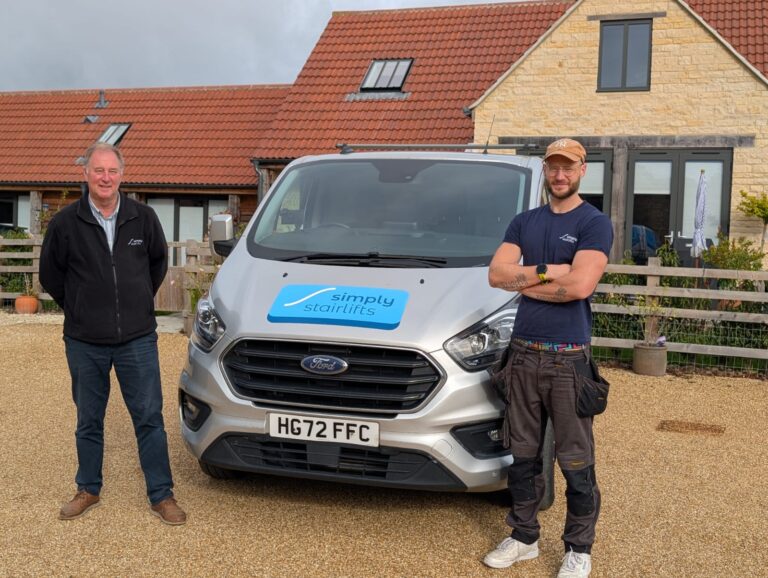
What matters is getting the right information early enough to make a decision. That’s exactly what Brian and Jack at Simply Stairlifts are here for: a free, no-obligation conversation about what would work in your home, with no pressure and no hard sell.
Whether you’re looking at a new stairlift, a reconditioned model, or just want honest advice before going near the grant process, you’re welcome to get in touch. Call us, email, or arrange a free home survey at a time that suits you.
Contact Simply Stairlifts today
Find out more helpful information about stairlifts on the Simply Stairlifts advice page…
Which Type of Stairlift is Right for You? | When is The Right Time to Buy a Stairlift? Signs it’s Time to Make the Move | How Safe is a Stairlift?
References:
GOV.UK, ‘Personal Independence Payment (PIP)’. Accessed on 28th July 2026.
GOV.UK, ‘Attendance Allowance’. Accessed on 28th July 2026.
Disclaimer: all facts and guidance provided in this article are accurate as of August 2026.