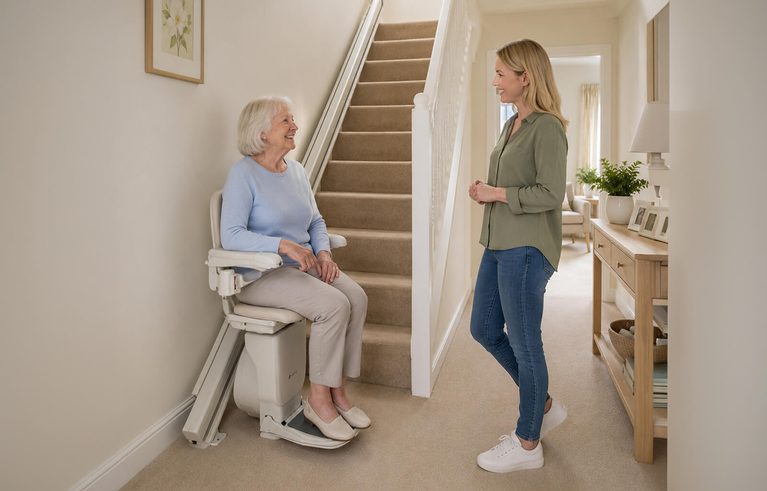
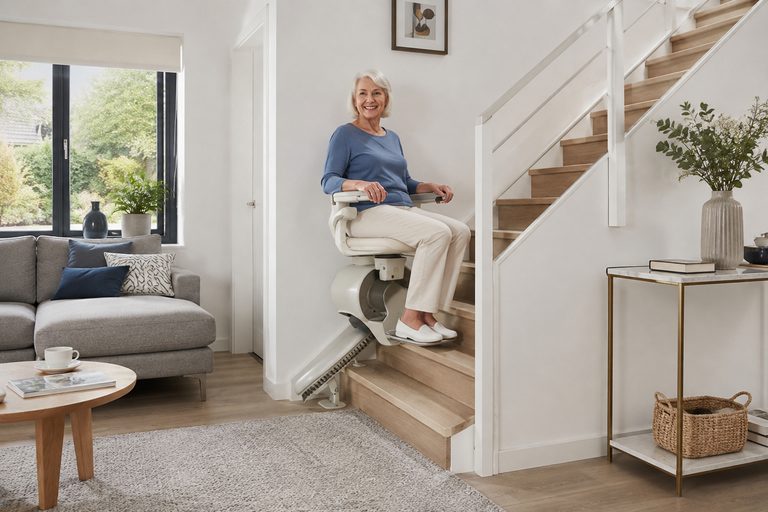
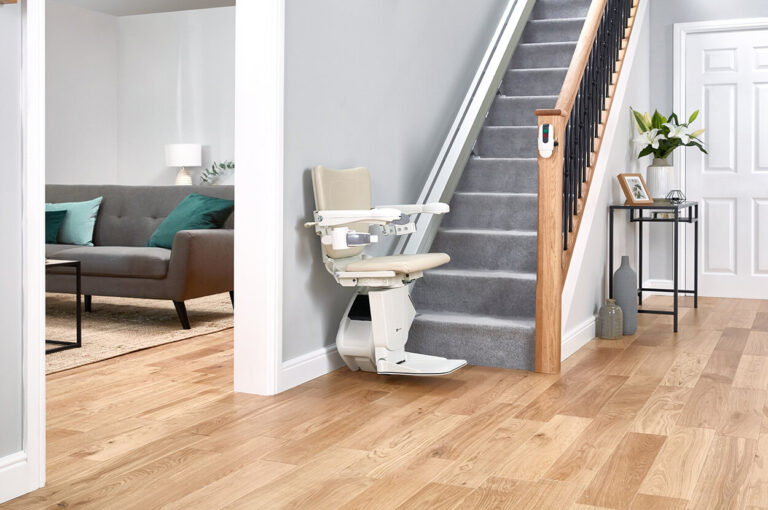
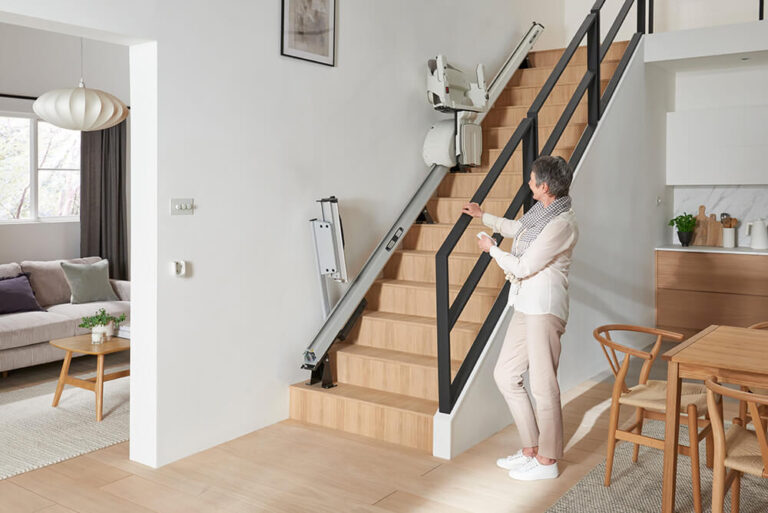
If you, or a loved one, cannot safely use the stairs, public grants, council-led adaptations, and a range of charitable funds are on hand to help you cover part or all of the cost of a stairlift.
This article provides a clear step-by-step playbook: who qualifies, how local authority and NHS assessments work, which benefits affect means testing, which charities can cover shortfalls, and the practical documents and quotes you’ll need to apply.
Keep reading, and the Simply Stairlifts team will tell you everything you need to know about stairlift grants and funding…
Stairlift funding: eligibility
Let’s get straight to the point: are you eligible to receive funding for the purchase and installation of a stairlift in your home (or the home of a relative)?
If you would like the stairlift to be fully funded, this will depend on two things (in England and Wales):
- Whether an occupational therapist and your local authority agree that a stairlift is necessary and appropriate.
- Your household’s financial position (note: adults are means tested, disabled children are not).
Should you successfully meet these criteria, then you are likely to qualify for stairlift funding – the primary source of which is something called the Disabled Facilities Grant (DFG).
Note: the Disabled Facilities Grant may not always fund the total cost of a stairlift. However, there are a number of charities and discretionary schemes available that can ‘top up’ the DFG grant in many instances.
Who most often gets full funding
So, who is most likely to receive full funding for the purchase of a stairlift? Naturally, this varies; however, as a common theme, the following people tend to receive full funding for a stairlift:
- Disabled children and young people: as we mentioned above, adaptations for children are not subject to means testing. As a result, any works/adaptations to a home recommended by a council assessment are usually funded in full.
- Adults on means-tested benefits: if you, or your relative, are on income-related benefits such as Guaranteed Pension Credit, income-related Employment Support Allowance (ESA), Jobseekers Allowance, Universal Credit (with limited earnings), or Housing Benefit – and the council determines that you need a stairlift – 100% of the cost is usually covered.
- Low-income homeowners and tenants: adults with low levels of savings and income will, frequently (but not always), pass the DFG means test and receive full funding. In some instances, they will pass the test, but only have to make a modest contribution to the remaining cost of the stairlift.
What does stairlift funding cover?
One of the most common questions we receive here at Simply Stairlifts is not merely what funding is available, but what the funding actually covers (after all, nobody wants the nasty surprise of an unexpected bill).
If your stairlift is going to be funded via the Disabled Facilities Grant (DFG), then you will find that this usually covers:
- The cost of the stairlift itself.
- The cost of installing the stairlift.
The funding can also often cover minor related works, such as small carpentry tasks or electrical work to make the stairlift fully functional and safe.
How much does a stairlift actually cost?
Aside from questions about funding, questions about the actual cost of stairlifts are amongst the most common we receive here at Simply Stairlifts.
Handily, we have created a detailed guide which provides much greater detail on this topic.
However, if you’re just looking for an initial ‘ballpark’ figure, then you’ll find that the average cost for a new straight stairlift, including installation, is around £2,275 (correct at the time of writing and subject to change).
The Disabled Facilities Grant (DFG): what you need to know
As we mentioned earlier, the Disabled Facilities Grant represents the single most significant public funding route for stairlift purchases and installations in England and Wales.
It is a means-tested grant that is administered by your local authority and has the primary aim of helping disabled people live safely and independently in their own homes.
It’s worth noting, at this point, that the DFG doesn’t just cover stairlifts. Furthermore, it can also cover other home adaptations such as level-access showers, ramps, and the widening of doorways. This can be useful to know should you or your relative have a broader range of mobility issues beyond climbing stairs alone.
How much funding can you get from the Disabled Facilities Grant?
The amount of funding you can obtain from the DFG is limited by a statutory cap. This cap varies depending on which nation you reside in.
- In England, the DFG cap is £30,000.
- In Wales, the DFG cap is £36,000.
Given that the average straight stairlift cost is in the region of £2,275, you’ll see that the DFG is usually easily able to cover the full cost of a stairlift and its installation.
What the disabled facilities grant will and won’t fund
Funding via the DFG can be used to cover all the necessary works associated with a stairlift installation. This can include any bespoke rail work and small pieces of carpentry work that are required to safely and securely fit the stairlift unit.
However, the DFG cannot be used to fund more general ‘home improvement’ style works. Any work to take place under the DFG must be necessary and appropriate and reasonable, and practicable.
The DFG assessment
As the disabled facilities grant will be administered by your local authority, it is this body that will be responsible for assessing whether you qualify.
These assessments are usually carried out by an occupational therapist (OT) or trained assessor from the local authority’s social services department (although, if the stairlift assessment is required during a hospital stay, the OT may be employed by your local NHS trust).
It’s the job of the OT to assess you – or your relative – and to determine any functional difficulties (for example, whether you can safely use the stairs). Based on this assessment, the OT will make a professional recommendation. It is this recommendation that determines whether you will be eligible for stairlift funding from the DFG.
Means-testing
An important part of the DFG application process is means-testing. This applies to adult applicants and involves the local authority determining whether you have the means to pay for the stairlift yourself.
Your local authority will assess your household income and savings to calculate whether you must make a contribution towards the cost of the stairlift.
Naturally, the key question here is – how much income/savings is too much?
The answer is that it varies depending on the local authority. Many will overlook a modest amount of savings (e.g. £6,000), and certain disability benefits are not classed as household income. In other words, if the applicant receives some form of benefit (e.g. Guaranteed Pension Credit, Housing Benefit, Universal Credit, etc), they effectively automatically qualify for the DFG.
Note: DFG awards do not typically affect your entitlement to other benefits.
You can apply for a Disabled Facilities Grant via this web portal.
Tip: the government funds an organisation called Foundations, that can help you or your relative apply for a grant.
Conditions of a disabled facilities grant
Similar to other forms of funding, disabled facilities grants are not ‘no strings attached’: they come with a series of conditions.
To begin with, most DFGs are not repayable whilst you continue to live in your property.
However, if you are an owner-occupier and have received a DFG of more than £5,000, the law allows your local authority to register a local land charge. This means if you sell your property within 10 years of the certified completion date (of the stairlift installation), the council may require you to pay back the part of the grant that exceeds £5,000 (up to a maximum liability of £10,000).
Remember, however, that most stairlift installations on average cost less than £5,000 – so the above condition wouldn’t apply.
Note: different local authorities have different conditions attached to their DFGs. Ensure you check the conditions outlined by your local authority before committing to a grant.
How long does it take to get a disabled facilities grant?
When you – or a relative – are in need of a stairlift, timelines matter.
So, how long should it be before you know if you are qualified for a DFG?
The good news is that there is a statutory requirement that local authorities must give a decision on a complete DFG application within six months. In reality, decisions can be made much faster, but it very much depends on the workload at your local authority.
Note: it is critically important that you don’t start or commission work before you have formal grant approval, as councils will not pay for work begun prior to an approved application.
The typical DFG application process
If you’ve decided you want to apply for a disabled facilities grant, then you will need to follow a process that looks like this:
- Needs assessment: you will need to contact your local adult social care department to request an assessment (in the form of a visit by an OT). This assessment effectively acts as the ‘gateway’ to the DFG application process.
- Gathering of quotes: local authorities usually expect you to gather at least two different quotes for the proposed work. If you’d like a quote tailored to the OT’s specification, the Simply Stairlifts team can help.
- Prepare financial documents: unless you are on some form of benefit (e.g. Universal Credit), you will need to gather financial documents for the means-testing part of the process. Ensure you have evidence of both ongoing income and savings.
- Check approval paperwork: if your local authority approves your DFG application, it’s vital that you check the approval paperwork with a fine-tooth comb (e.g. look for any contribution you may be required to pay, possible repayment charges, etc). Also, check whether the local authority will pay the contractor directly for the work completed.
The NHS and stairlifts
A common misconception is that the NHS provides funding for stairlifts. This isn’t the case.
However, NHS teams – particularly occupational therapists – play an important role in helping individuals secure funding for stairlifts. They provide the assessment, clinical evidence, and referrals that lead to a successful DFG application. In certain instances, the NHS can also help accelerate funding decisions.
The NHS can assist by:
- Providing an assessment of functional need: NHS OTs assess how a medical condition, injury, or frailty affects a person’s ability to use the stairs safely. Their report will state – in clinical terms – the precise limitation, and why an adaptation such as a stairlift is required.
- Conducting risk analysis and mitigation: NHS staff will document any fall risk, history of falls, and other acute clinical reasons why stair use is unsafe. This can often be the trigger that persuades a local authority that a stairlift is necessary, rather than merely desirable.
- Discharge planning: for patients in hospital who need adaptations to return home safely, OTs play a critical role in accelerating needs assessments and funding decisions. In some NHS trusts, OTs will escalate cases where delayed discharge is due to unsuitable home access.
- Providing formal referrals and supporting paperwork: the NHS can provide formal referral letters, discharge summaries, fall assessments, and OT reports. These can help bolster and support an application for a disabled facilities grant.
The question you’re probably left with is, “why doesn’t the NHS fund stairlifts?”. The answer is relatively simple. As stairlifts are treated as a housing adaptation – capital work to the structure of a home – this responsibility sits with the local authority, not the NHS.
Documents to request from the NHS
Should you or a relative end up in hospital and require the installation of a stairlift, then the following documentation may be available from your NHS team:
- OT assessment report.
- Falls risk assessment or incident reports.
- Discharge summary (if applicable).
- Medical or consultant letter (where relevant and/or available).
- Care plan or domiciliary needs (if available).
These documents can prove to be very persuasive to local authority decision makers (and other charitable funders), as they translate day-to-day difficulties into professional clinical evidence.
Disability benefits and stairlift funding
As we saw earlier, being on certain benefits can effectively ‘fast-track’ you to stairlift funding, mitigating the need for means-testing. In this next section, we’ll take a deeper dive into specific benefits and how they can affect your stairlift funding application.
Income-related benefits
The following income-related benefits effectively “passport” you to a full stairlift funding grant by exempting you from paying a contribution. Examples of these benefits include:
- Guaranteed Pension Credit.
- Income-related Employment and Support Allowance (ESA).
- Income Support.
- Income-based Jobseeker’s Allowance (JSA).
- Housing Benefit.
- Universal Credit (where entitlement is to an income-related element).
Note: it is important that you check your local authority’s criteria regarding benefits and stairlift funding, as this can vary from authority to authority.
Disability-specific benefits
In addition to income-related benefits, there are a number of disability-specific benefits that are not counted as income (and thus won’t affect your application for stairlift funding). These benefits include:
- Personal Independence Payment (PIP).
- Attendance Allowance.
- Disability Living Allowance (DLA).
These benefits are intended to help with the extra costs of disability, and are therefore typically excluded from any sort of means-test.
Charitable and community sources of stairlift funding
Should you find yourself in a position where your disabled facilities grant (DFG) does not cover the full cost of the stairlift and its installation, there are a number of charitable and community funding sources that can potentially provide a ‘top up’ grant and help bridge the difference.
In this next section, we’ll provide you with an overview of the main charitable funders that have been known to support stairlift installations.
National charities and trusts
There are a handful of major national charities and trusts that regularly fund home adaptations and stairlifts. These include:
- Independence at Home: this organisation provides grants for disabled adults to enable independent living. Typical awards from Independence at Home tend to be for equipment or adaptations that have not been funded from statutory sources. Funding available is often fairly modest (from the mid-hundreds to the low thousands) and applications must be made by an OT or social worker.
- Margaret’s Fund: established in 1927, Margaret’s Fund is a smaller funder that provides grants to women with disability-related needs. Grants tend to be in the mid-hundreds, whilst applications must be made by a health or social care professional.
- SSAFA and military charities: a number of military charities – most notably the SSAFA – can help fund stairlifts for ex-service personnel and their families that require them. Proof of service and an assessment are required to make an application.
- R.A.B.I.: the Royal Agricultural Benevolent Institution, as the name suggests, supports people from farming backgrounds who require household adaptations.
- Edward Gostling Foundation: although this body no longer accepts direct applications, it does accept applications via a series of partner charities. The Edward Gostling Foundation has been known to fund stairlift installations in recent years.
A common thread across these funders is that the available grants are modest; meaning they are only really suitable to ‘top up’ an existing DFG.
Local charities and trusts
In addition to the national bodies outlined above, there are hundreds of smaller, local charities and trusts that may be able to provide you with a small amount of financial support.
The easiest way to find a local charity or trust near you is to use a web portal such as turn2us which can put you in contact with appropriate local grant funders.
Another potential source of funding can be local faith groups and civic organisations. Bodies such as local Lions Clubs, Rotary Clubs, and church funds have been known to make one-off grants to support individuals in particular hardship.
What if I can’t get a grant?
In the worst-case scenario, you may find that you are unable to obtain any sort of grant for a stairlift. In which case, it’s time to explore some alternatives.
Reconditioned/refurbished stairlifts
A cost-effective alternative is to purchase a reconditioned stairlift. These are stairlifts that have been previously installed and used, and subsequently inspected, refurbished, safety-tested and recommissioned by a specialist (such as Simply Stairlifts).
Purchasing a refurbished stairlift can bring a number of advantages, including:
- A lower upfront purchase price.
- Faster availability.
Refurbished stairlifts aren’t without their downsides, though. For example, it’s very rare to find reconditioned curved stairlifts; this is because curved staircases usually require a bespoke rail, which often makes a second-hand unit impractical.
Stairlift rental
Another good alternative is to rent a stairlift. This is the perfect option if you only need a stairlift for a short period (e.g. recovering from surgery). It’s also a potential option if you are awaiting a decision on a DFG grant; a rented model can act as a ‘bridging solution’ until you have the grant confirmed for a permanent stairlift.
Whilst renting a stairlift can be a generally good option, it does have some downsides. These include a higher cost over the long-term, and limited choice.
VAT relief
A further option is to claim VAT relief on the purchase of a stairlift. Provided you are eligible (e.g. able to declare that you are suffering from chronic sickness/disability and will only be using the stairlift for personal use), this route can save you a sizeable amount of money.
Note: if you wish to claim VAT relief, it’s critical that you discuss this with the stairlift supplier before you proceed with a purchase.
Stairlift funding FAQs
We appreciate that we’ve covered a great deal of information in this article. So, let’s recap the most commonly asked questions about stairlift funding.
Can I get a grant for a stairlift?
Yes. Provided you meet the appropriate means-testing criteria and have a suitable assessment from an occupational therapist (OT), you can qualify for a disabled facilities grant (DFG), which will cover the cost of a stairlift at home.
Will my council pay for a stairlift?
In short, yes. In the majority of cases, the stairlift will be funded via the disabled facilities grant, but facilitated by your local authority’s social care department. Again, this is all dependent on you meeting the relevant qualification criteria.
Note: a few councils have their own adaptation services that may be able to provide a stairlift directly.
Can you get a stairlift on the NHS?
No. The NHS does not provide stairlifts directly. However, the NHS can help with the process, providing clinical assessments, fall risk analyses, and referrals, which can all speed up the stairlift funding process.
Can you get a stairlift if you’re on disability benefits?
Yes. If you are receiving disability benefits, you may qualify for a disabled facilities grant. In many cases, the receipt of disability benefits means you can ‘skip’ the means-testing process and proceed straight to the application stage.
Can I get a free stairlift?
In short, yes. Many people are able to get a stairlift at no cost to themselves. This is dependent on meeting a series of eligibility criteria (such as being in receipt of benefits, having a low income, and low/no savings).
How long does the DFG process take?
Statutorily, your local council must provide a decision on your disabled facilities grant within six months of application.
Secure a stairlift with Simply Stairlifts
We hope you’ve found our guide to funding a stairlift informative and useful. So, what have we learnt?
Firstly, the disabled facilities grant (DFG) is likely going to be your best route for securing stairlift funding (if you live in England and Wales).
Secondly, it’s incredibly important to have clinical evidence and an appropriate assessment done at the beginning of your application – it’s these things that demonstrate the necessity of a stairlift.
Finally, charities and other trusts may be able to help fill any funding gaps you experience.
So, what’s your next step? If you’re thinking of sourcing a stairlift for your home, the next thing you should do is speak to the Simply Stairlifts team for a free, no-obligation conversation about your needs.
Contact our team now
Find out more helpful information about stairlifts on the Simply Stairlifts blog…
How Much Does a Stairlift Cost? | What to Look for In a Stairlift Supplier | How Much Electricity Does a Stairlift Use?